
AIOps
AIOps explained: how AI-driven operations combine machine learning, big data, and automation to help IT teams detect, diagnose, and resolve incidents faster — with real benefits, challenges, and implementation steps.
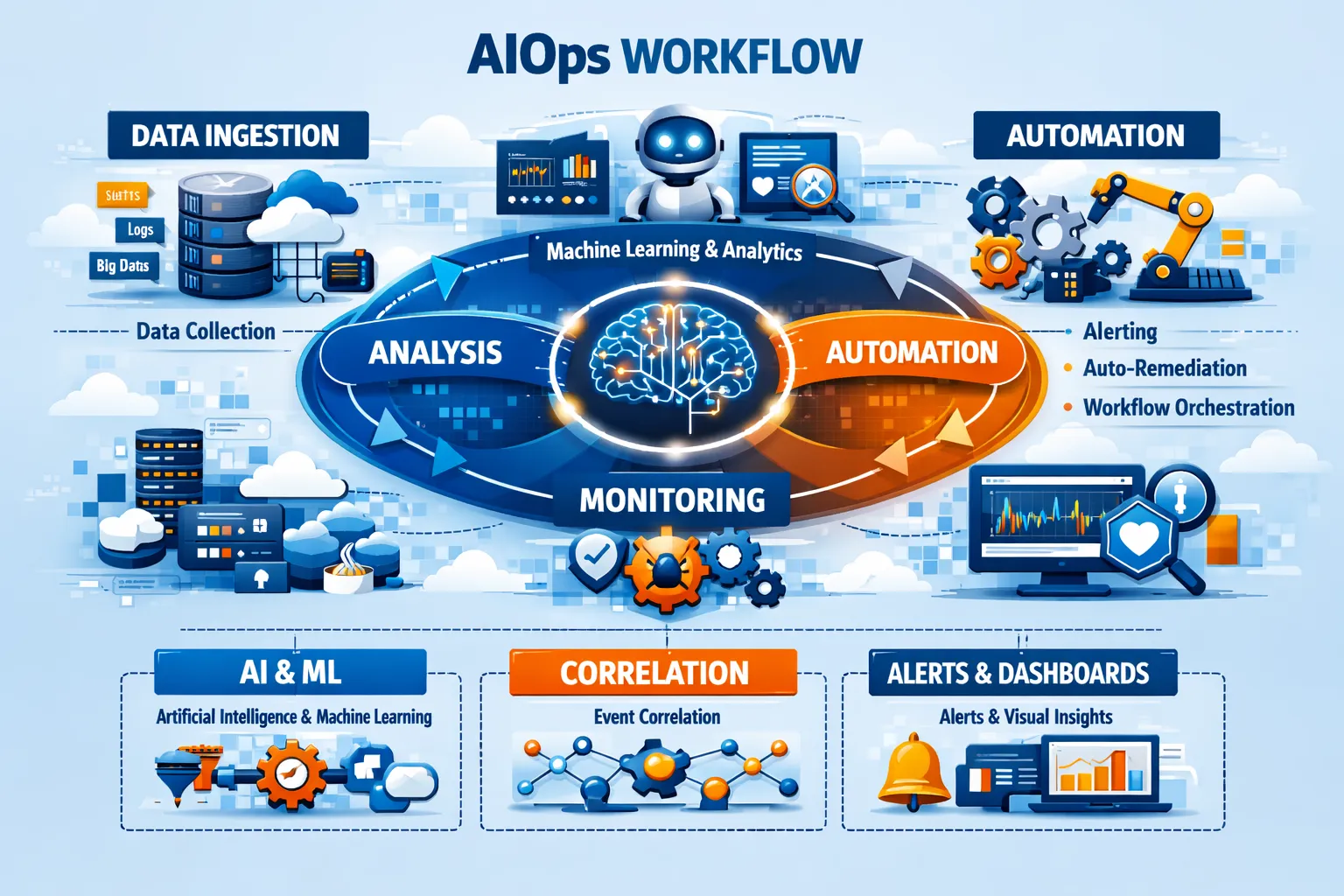
How Artificial Intelligence Is Reshaping IT Operations
Modern IT environments have become too large, too fast-moving, and too interconnected for humans to monitor manually. A single e-commerce platform might generate millions of log lines per hour, run across dozens of microservices, and depend on cloud infrastructure that scales up and down automatically. When something breaks at 3 a.m., the traditional approach — waking up an engineer, digging through dashboards, and correlating alerts by hand — is no longer fast enough. This is the problem AIOps was built to solve.
What Is AIOps?
AIOps stands for Artificial Intelligence for IT Operations. The term was coined by Gartner around 2016 to describe platforms that apply machine learning, big data analytics, and automation to IT operations tasks such as monitoring, event correlation, anomaly detection, and incident response.
Rather than replacing human engineers, AIOps acts as an intelligent layer between raw operational data (logs, metrics, traces, events, tickets) and the people who need to act on it. It ingests enormous volumes of telemetry from every layer of the stack — infrastructure, network, applications, and cloud services — and uses algorithms to find patterns that would be invisible or too slow to spot manually.
Why AIOps Matters Now
Several trends have converged to make AIOps not just useful but necessary:
- Explosive data growth. Distributed systems, containers, and microservices produce far more telemetry than any team can review manually.
- Increasing system complexity. A single user request might touch dozens of services, each with its own logs and metrics, making root-cause analysis a genuine needle-in-a-haystack problem.
- Alert fatigue. Traditional monitoring tools often generate thousands of alerts a day, most of which are noise. Engineers become desensitized and start missing the alerts that actually matter.
- Business pressure for uptime. Downtime is expensive and reputationally damaging, and customers expect near-instant recovery from outages.
- Talent shortages. Skilled site reliability engineers (SREs) and operations staff are in short supply, so organizations need tools that multiply the effectiveness of the people they already have.
Core Capabilities of AIOps Platforms
While implementations vary, most AIOps platforms are built around a few core capabilities:
1. Data Aggregation and Correlation
AIOps tools pull in data from many sources — logs, metrics, traces, events, configuration management databases, and even ticketing systems — and normalize it into a common format. This is the foundation everything else is built on; without unified data, pattern detection is impossible.
2. Anomaly Detection
Instead of relying on static thresholds (“alert if CPU exceeds 90%”), machine learning models learn what “normal” looks like for each system over time and flag deviations automatically. This catches subtle issues — like a slow memory leak or gradual latency creep — that static rules would miss entirely.
3. Event Correlation and Noise Reduction
When a single root cause triggers hundreds of downstream alerts, AIOps platforms cluster related events into a single incident. This is one of the most immediately valuable capabilities, because it directly reduces alert fatigue and helps engineers focus on causes rather than symptoms.
4. Root Cause Analysis
By analyzing dependencies, timing, and historical incident data, AIOps systems can suggest the likely origin of a problem — for example, pinpointing that a checkout service outage was actually caused by a database connection pool exhaustion three services upstream.
5. Predictive Analytics
More mature platforms move from reactive to predictive: forecasting capacity needs, predicting disk failures before they happen, or flagging a deployment that is statistically likely to cause a regression based on patterns from past releases.
6. Automated Remediation
The most advanced AIOps implementations close the loop entirely, triggering automated runbooks or self-healing actions — restarting a failed service, scaling a resource, or rolling back a bad deployment — without waiting for a human to intervene.
Real-World Benefits
Organizations that adopt AIOps well tend to see improvements across several dimensions:
- Faster mean time to detect (MTTD) and mean time to resolve (MTTR), since correlation and root-cause tools cut through the noise far faster than manual triage.
- Reduced alert volume, freeing engineers to focus on genuinely important issues rather than chasing false positives.
- Better resource utilization, as predictive capacity planning avoids both costly over-provisioning and risky under-provisioning.
- Improved collaboration, since a single, correlated view of an incident gives development, operations, and business stakeholders a shared source of truth during an outage.
- Proactive problem prevention, catching issues in early stages before they escalate into customer-facing outages.
Common Challenges and Pitfalls
AIOps is powerful, but it is not a plug-and-play fix. Common obstacles include:
- Data quality and silos. If logs and metrics are inconsistent, incomplete, or scattered across disconnected tools, the AI has poor raw material to work with, and results suffer accordingly.
- Trust and adoption. Engineers who have been burned by noisy monitoring tools in the past are often skeptical of automated recommendations, and it takes time — and consistent accuracy — to earn their trust.
- Overreliance on automation. Fully automated remediation is powerful, but if implemented carelessly it can also automate a bad decision at scale, turning a small problem into a big one very quickly.
- Tool sprawl. Many organizations bolt AIOps features onto an already crowded observability stack, creating yet another dashboard rather than a unified solution.
- Unclear ROI at the outset. Because AIOps often shows its value gradually — through fewer incidents and faster resolutions rather than one dramatic win — it can be hard to build the initial business case.
How to Approach an AIOps Implementation
- Start with observability fundamentals. AIOps only works as well as the data feeding it. Before adding intelligence, make sure logging, metrics, and tracing are consistent and comprehensive.
- Pick a narrow, high-value use case first. Alert noise reduction or event correlation is often the easiest entry point, since it delivers a fast, visible win without requiring full automated remediation from day one.
- Keep humans in the loop initially. Use AI-driven insights to assist decision-making before trusting the system with fully automated actions. Confidence should be earned incrementally.
- Measure the right metrics. Track MTTD, MTTR, alert volume, and false-positive rates before and after implementation, so the value of the initiative is visible and defensible.
- Iterate. Treat AIOps as an evolving capability, not a one-time deployment. Models need to be retrained and tuned as systems and traffic patterns change.
The Future of AIOps
AIOps is converging with several other trends that will shape where it goes next:
- Generative AI for operations. Large language models are increasingly used to summarize incidents in plain language, draft postmortems automatically, and let engineers query system state conversationally instead of writing complex queries.
- Deeper integration with DevOps and platform engineering. AIOps is moving upstream, informing decisions during development and deployment rather than only reacting after something breaks in production.
- Autonomous operations. As trust in AI-driven remediation grows, more organizations are extending automation from “detect and recommend” to “detect and fix,” particularly for well-understood, low-risk failure patterns.
- FinOps convergence. AIOps techniques are increasingly being applied to cloud cost data as well as performance data, helping teams optimize spend using the same anomaly-detection and correlation techniques built for reliability.
Conclusion
AIOps is not a single product but a capability: the application of AI and machine learning to make IT operations faster, quieter, and more predictive. Done well, it turns operations from a reactive, alert-driven scramble into a proactive discipline where problems are often caught — and sometimes fixed — before anyone notices. The organizations getting the most value from AIOps today are the ones treating it as a long-term investment in better data and gradually earned trust, not a shortcut around the hard work of good observability.