
DevOps
DevOps explained: how culture, automation, and collaboration between development and operations teams speed up software delivery while improving reliability — covering principles, practices, tools, benefits, and challenges.
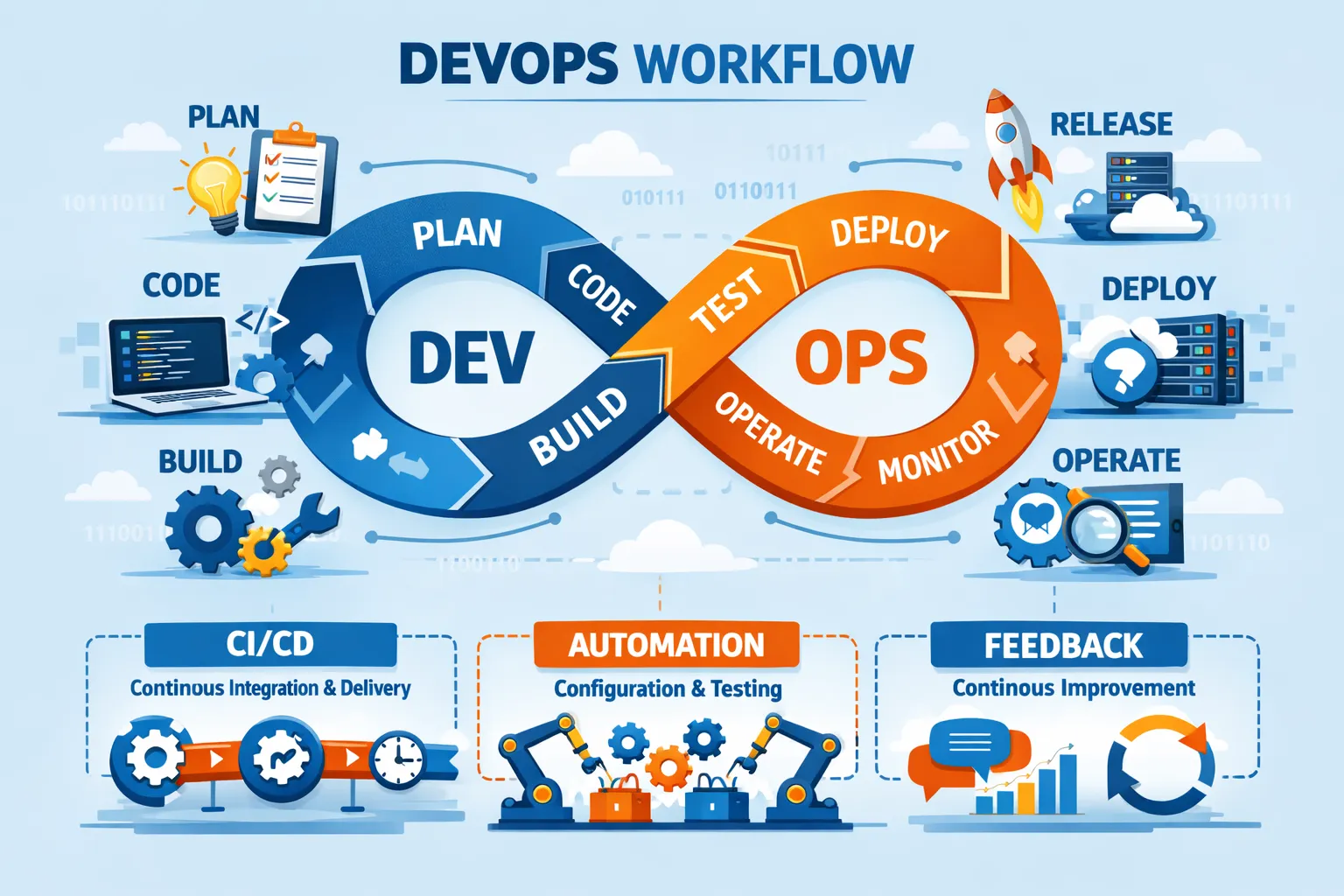
DevOps Bridging Development and Operations for Faster, Reliable Software
For decades, software development and IT operations lived in separate worlds. Developers wrote code and threw it “over the wall” to operations teams, who were responsible for deploying and keeping it running. The two groups had different goals, different incentives, and often different tools — developers wanted to ship features fast, while operations wanted stability and were wary of change. The result was slow, painful releases, finger-pointing during outages, and software that took months to go from idea to production. DevOps emerged as a direct response to this dysfunction.
What Is DevOps?
DevOps is a combination of cultural philosophy, organizational practices, and tooling that unifies software development (Dev) and IT operations (Ops). Its core goal is to shorten the software development lifecycle while delivering features, fixes, and updates frequently and reliably, in close alignment with business objectives.
Importantly, DevOps is not a single tool or job title — it’s a way of working. It emphasizes collaboration, shared responsibility, automation, and continuous improvement across the entire path from writing code to running it in production.
The Core Principles of DevOps
1. Collaboration Over Silos
Development, operations, QA, and security teams work together throughout the entire lifecycle rather than handing work off at fixed stage gates. Shared goals and shared metrics replace departmental finger-pointing.
2. Automation Everywhere
Manual processes are slow and error-prone. DevOps pushes automation into every possible stage: building code, running tests, provisioning infrastructure, deploying releases, and monitoring systems in production.
3. Continuous Integration and Continuous Delivery (CI/CD)
Developers merge code changes frequently — often multiple times a day — into a shared repository, where automated builds and tests run immediately. Continuous delivery extends this further, keeping code in a state where it can be released to production at any time, sometimes automatically.
4. Infrastructure as Code (IaC)
Servers, networks, and environments are defined and managed through version-controlled code rather than manual configuration. This makes infrastructure reproducible, auditable, and far easier to scale or roll back.
5. Monitoring and Feedback Loops
Continuous monitoring of applications and infrastructure gives teams real-time visibility into how changes affect production, closing the feedback loop so problems are caught early rather than discovered by customers.
6. Shared Responsibility for Reliability
Rather than operations being solely accountable for uptime, DevOps distributes ownership: “you build it, you run it.” Developers who write code also carry responsibility for how it behaves in production.
Key DevOps Practices
- Version control for all code and configuration, giving teams a single source of truth and full traceability of changes.
- Automated testing at multiple levels (unit, integration, end-to-end) so regressions are caught before they reach production.
- Continuous integration, merging and testing code changes constantly to avoid painful, risky “big bang” merges.
- Continuous deployment/delivery, automating the path from a merged commit to a running production release.
- Configuration management, ensuring environments stay consistent across development, staging, and production.
- Containerization and orchestration, packaging applications with their dependencies so they run identically everywhere, and coordinating them at scale.
- Observability, combining logs, metrics, and traces to understand system behavior, not just detect that something is broken.
- Incident management and blameless postmortems, treating failures as learning opportunities rather than occasions for blame.
The DevOps Toolchain
While DevOps is fundamentally about culture, a mature ecosystem of tools supports each stage of the lifecycle:
- Version control: Git, along with platforms like GitHub, GitLab, and Bitbucket.
- CI/CD: Jenkins, GitLab CI, GitHub Actions, CircleCI.
- Configuration management and IaC: Ansible, Terraform, Puppet, Chef.
- Containerization and orchestration: Docker and Kubernetes.
- Monitoring and observability: Prometheus, Grafana, Datadog, the ELK/Elastic stack.
- Collaboration and incident response: Slack, PagerDuty, Jira, Opsgenie.
No single toolchain is “correct” — the right combination depends on team size, existing infrastructure, and the specific problems being solved. Tools support the DevOps philosophy; they don’t replace it.
Benefits of Adopting DevOps
Organizations that successfully adopt DevOps typically see:
- Faster time to market, since automated pipelines and smaller, more frequent releases replace slow, high-risk quarterly deployments.
- Higher release quality, as automated testing and consistent environments catch problems earlier and more reliably than manual QA alone.
- Improved reliability, since infrastructure as code and continuous monitoring reduce configuration drift and catch issues before they escalate.
- Faster recovery from failures, because smaller, more frequent releases are easier to roll back and diagnose than large, infrequent ones.
- Better team morale and reduced burnout, as blameless postmortems and shared ownership replace the adversarial dynamic between “the people who build it” and “the people who get paged for it.”
- Stronger alignment with business goals, since shorter feedback loops mean customer and market feedback shapes the product faster.
Common Challenges in DevOps Adoption
DevOps transformations frequently stumble on the same set of obstacles:
- Cultural resistance. Long-standing organizational silos and incentive structures don’t dissolve just because new tools are introduced; leadership buy-in and genuine behavioral change are required.
- Tool sprawl without process change. Adopting CI/CD tools while keeping the old approval chains and handoffs in place delivers little of the actual benefit.
- Security as an afterthought. Moving fast without integrating security practices into the pipeline (an approach often called DevSecOps) can introduce serious risk.
- Skill gaps. Operations engineers need to learn coding and automation; developers need to understand infrastructure and production concerns — and this transition takes real investment in training.
- Measuring the wrong things. Focusing purely on deployment frequency without also tracking failure rate and recovery time can create a false sense of progress.
Where DevOps Is Heading
Several trends are shaping the next phase of DevOps:
- Platform engineering. Organizations are building internal developer platforms that package DevOps best practices into self-service tools, reducing the cognitive load on individual developers.
- GitOps. Using Git repositories as the single source of truth for both application and infrastructure state, with automated reconciliation between the desired and actual state of a system.
- AI-assisted operations. Machine learning is increasingly used to detect anomalies, correlate incidents, and even suggest or apply fixes — a convergence often described as AIOps working alongside traditional DevOps practices.
- DevSecOps. Security is being pulled earlier into the pipeline (“shifting left”), with automated vulnerability scanning and compliance checks built directly into CI/CD.
- FinOps. As cloud costs grow, DevOps principles are increasingly extended to cost visibility and optimization, treating spend as another metric to monitor and improve continuously.
Conclusion
DevOps succeeded where earlier attempts at process improvement failed because it addresses both the human and the technical sides of software delivery at once. Automation and tooling make rapid, reliable releases possible, but it’s the cultural shift — shared ownership, blameless learning, and tight feedback loops — that makes those releases sustainable. Organizations that treat DevOps purely as a toolchain to install tend to see limited results; those that treat it as an ongoing change in how teams collaborate tend to see lasting improvements in both delivery speed and system reliability.