
DataOps
DataOps explained: how agile methods, automation, and DevOps principles applied to data pipelines help organizations deliver faster, higher-quality, more reliable analytics — covering principles, practices, tools, and challenges.
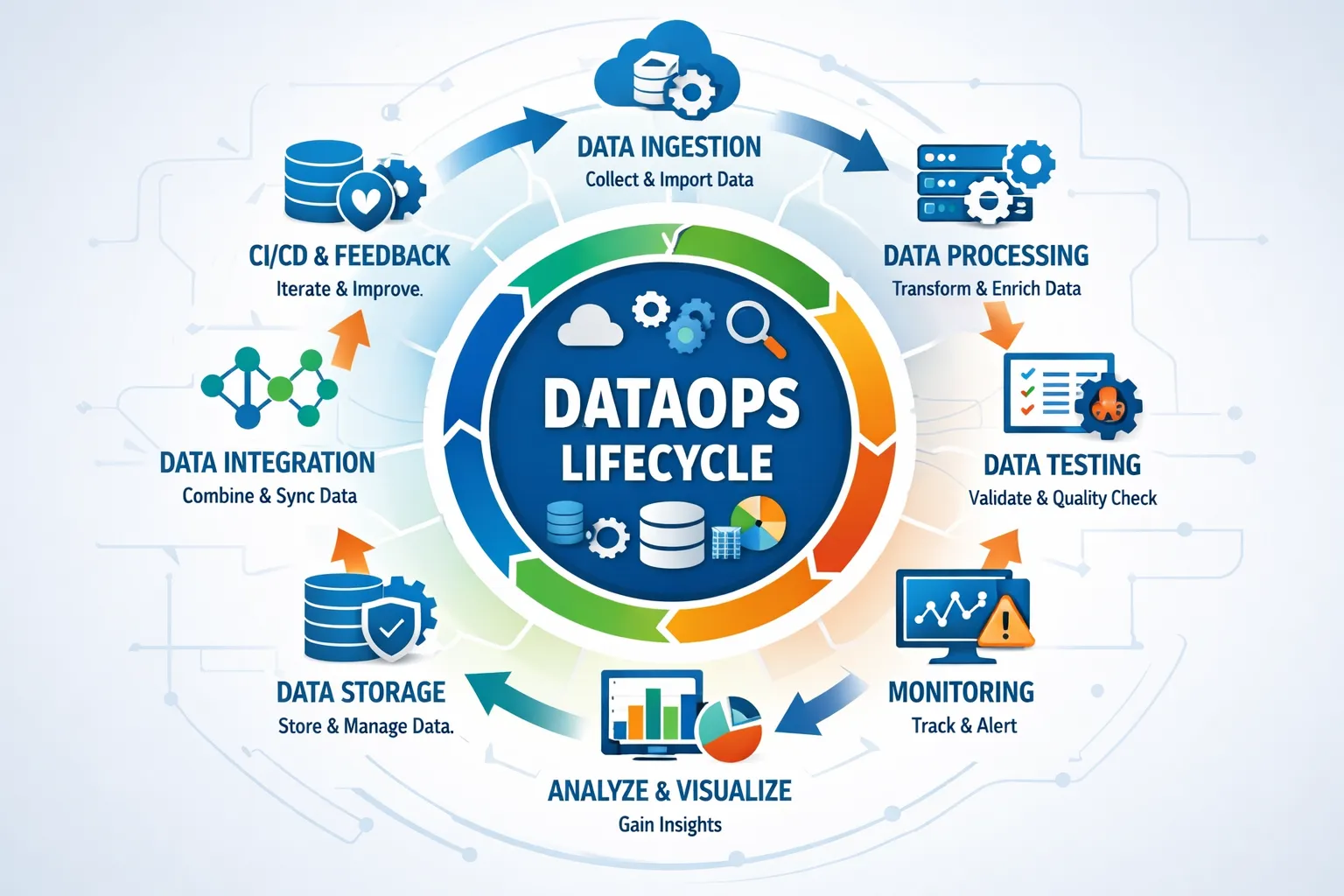
DataOps is Bringing Speed and Reliability to the Data Pipeline
Data teams have long struggled with a familiar pattern: a business stakeholder asks for a new report or dataset, and what should take days takes weeks or months. Pipelines break silently. Dashboards show numbers nobody trusts. Data scientists spend most of their time cleaning data rather than analyzing it. As organizations became more data-driven, these inefficiencies stopped being a minor annoyance and became a genuine competitive liability. DataOps emerged as the discipline that applies the lessons of DevOps — automation, collaboration, and continuous improvement — to the world of data.
What Is DataOps?
DataOps (short for Data Operations) is a set of practices, cultural principles, and technologies that improve the speed, quality, and reliability of the entire data lifecycle: from ingestion and transformation to analytics and delivery. It borrows heavily from Agile software development and DevOps, applying concepts like continuous integration, automated testing, and version control to data pipelines instead of application code.
Where DevOps asks “how do we ship code faster and more reliably,” DataOps asks “how do we ship trustworthy data faster and more reliably.” The end goal is the same: shorter cycle times, fewer errors, and tighter feedback loops between the people building the pipelines and the people using the data.
Why DataOps Matters
Several forces have made DataOps necessary rather than optional:
- Data volume and complexity have exploded. Organizations now pull data from dozens or hundreds of sources — SaaS tools, databases, event streams, third-party APIs — and stitching it all together reliably is a serious engineering challenge.
- Business demands for real-time insight. Batch reports that update once a day are no longer sufficient for many use cases, from fraud detection to inventory management.
- Data quality problems erode trust. When a dashboard shows an obviously wrong number, business users stop trusting all data, even when it’s correct, which undermines the entire purpose of a data function.
- Growing complexity of data teams. Data engineers, analysts, data scientists, and business stakeholders all touch the same pipelines, often with poor coordination, duplicated effort, or conflicting assumptions about definitions and data ownership.
- Regulatory and compliance pressure. Regulations like GDPR make data lineage, access control, and auditability a requirement rather than a nice-to-have.
Core Principles of DataOps
1. Treat Data Pipelines Like Software
Pipelines are version-controlled, tested, and deployed through automated processes rather than being built and modified manually and inconsistently.
2. Continuous Integration and Delivery for Data
Just as DevOps automates the path from code commit to production deployment, DataOps automates the path from a pipeline change to validated, deployed data — running automated tests at each stage to catch problems before they reach dashboards or downstream systems.
3. Automated Testing and Data Quality Checks
Every stage of a pipeline is validated automatically: schema checks, null-value thresholds, referential integrity, statistical distribution checks, and business-rule validation. Problems are caught at the source rather than discovered by a confused stakeholder days later.
4. Monitoring and Observability
Pipelines are monitored continuously for freshness, volume anomalies, and schema drift, with alerts firing before bad data reaches production dashboards — the data equivalent of application performance monitoring.
5. Collaboration Across Roles
Data engineers, analysts, data scientists, and business users work from shared definitions and shared tooling rather than each maintaining their own siloed version of “the truth.”
6. Continuous Improvement
Feedback from data consumers — including reported errors and changing requirements — feeds directly back into how pipelines are built and prioritized, creating the same kind of tight feedback loop DevOps established for application code.
Key DataOps Practices
- Version control for pipeline code and configuration, giving full traceability of every transformation applied to data.
- Automated pipeline testing, checking data at every stage rather than only inspecting final outputs.
- Data lineage tracking, so anyone can trace a number on a dashboard back through every transformation to its original source.
- Environment parity, ensuring development, staging, and production data environments behave consistently.
- Data contracts, formal agreements between data producers and consumers about schema, format, and update frequency, reducing silent breaking changes.
- Self-service access with guardrails, letting analysts and data scientists access data safely without waiting on engineering for every request.
- Incident management for data, applying the same blameless postmortem discipline used in DevOps when a pipeline fails or bad data reaches production.
The DataOps Toolchain
A mature DataOps practice typically draws on tools across several categories:
- Orchestration: Apache Airflow, Dagster, Prefect.
- Transformation: dbt (data build tool), Spark.
- Data quality and testing: Great Expectations, Soda, Monte Carlo.
- Version control and CI/CD: Git, combined with CI/CD platforms like GitHub Actions or GitLab CI, adapted for pipeline deployment.
- Data catalog and lineage: DataHub, Atlan, Collibra.
- Storage and processing: Cloud data warehouses and lakehouses such as Snowflake, BigQuery, Redshift, and Databricks.
As with DevOps, the tools support the discipline — they don’t substitute for the cultural and process changes DataOps requires.
Benefits of Adopting DataOps
Organizations that implement DataOps effectively typically see:
- Faster delivery of new data products and reports, since automated, tested pipelines replace slow, manual, one-off development.
- Higher data quality and trust, as automated validation catches errors before they reach decision-makers.
- Reduced pipeline downtime and faster incident recovery, since monitoring and clear ownership shorten the time between a failure occurring and being fixed.
- Better collaboration between technical and business teams, since shared definitions and self-service tooling reduce the back-and-forth of ad hoc requests.
- Improved compliance and auditability, since lineage tracking and version control make it far easier to answer “where did this number come from” and “who had access to this data.”
Common Challenges
DataOps adoption tends to run into a recognizable set of obstacles:
- Cultural resistance. Data teams accustomed to manual, ad hoc processes can be reluctant to adopt the discipline of automated testing and version control, particularly under pressure to deliver quickly.
- Legacy pipeline debt. Years of undocumented, manually maintained pipelines are difficult and risky to bring under proper version control and automated testing after the fact.
- Tool fragmentation. The modern data stack has many specialized tools, and integrating them into a coherent, automated workflow takes real engineering investment.
- Unclear data ownership. Without clear accountability for specific datasets, quality issues fall into gaps between teams and nobody feels responsible for fixing them.
- Balancing speed and governance. Moving fast with self-service access can conflict with the need for security, privacy, and regulatory compliance if guardrails aren’t designed carefully.
The Future of DataOps
Several trends are shaping how DataOps continues to evolve:
- AI-assisted data engineering. Machine learning is increasingly used to detect anomalies automatically, suggest schema changes, and even generate pipeline code from natural-language descriptions.
- Real-time and streaming DataOps. As more use cases demand real-time data, DataOps practices are extending beyond batch pipelines to streaming architectures built on tools like Kafka and Flink.
- Data mesh architectures. Rather than a single centralized data team owning everything, data mesh distributes ownership of specific datasets to the domain teams that understand them best, treating data as a product with DataOps discipline applied at the domain level.
- Convergence with MLOps. As machine learning becomes more central to business operations, the boundary between DataOps (managing data pipelines) and MLOps (managing model pipelines) is increasingly blurred, with shared tooling and shared practices.
- Stronger governance automation. Privacy regulations and AI governance requirements are pushing automated policy enforcement — access control, data masking, retention rules — directly into the pipeline rather than being handled as a separate manual process.
Conclusion
DataOps applies a simple but powerful idea to a domain that badly needed it: treat data pipelines with the same engineering discipline software teams have used for years — version control, automated testing, continuous delivery, and tight feedback loops. The organizations getting the most value from DataOps aren’t the ones with the fanciest tools; they’re the ones that have made data quality and pipeline reliability a shared, cultural responsibility rather than an afterthought bolted on after something breaks.