Ops
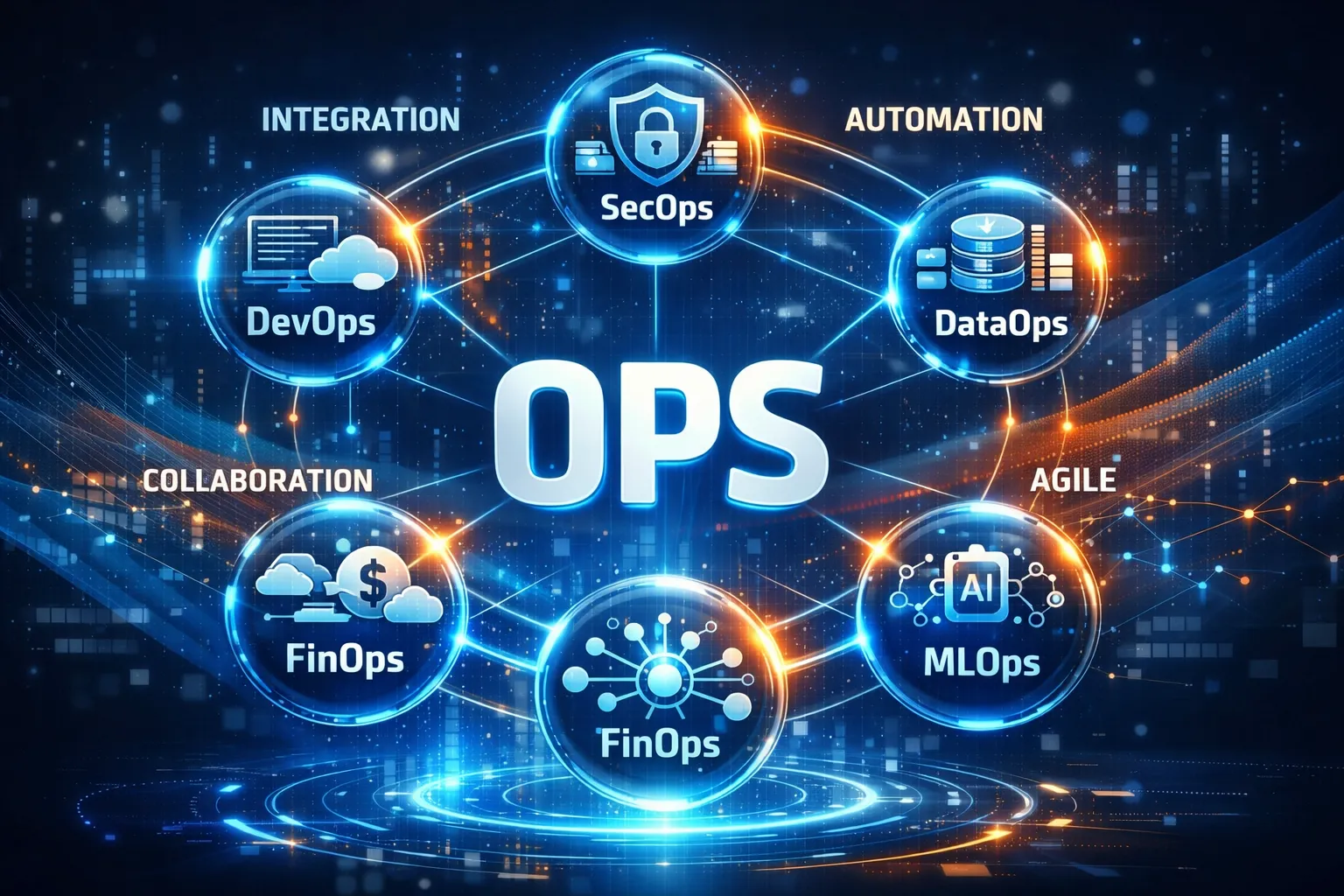
The suffix “Ops” symbolizes the integration of disciplines aiming to improve specific operational areas, often by automation and agile practices.
What “Ops” Really Means
At its core, “Ops” refers to operations—the processes that keep systems running, secure, scalable, and efficient. But in modern usage, “Ops” has evolved far beyond its literal meaning.
Today, “Ops” implies:
- Integration of multiple disciplines
- Automation to reduce manual work and human error
- Agile and lean practices for continuous improvement
- Shared responsibility across teams
- End‑to‑end visibility into systems and workflows
In other words, “Ops” is not a tool or a technology. It is a philosophy of operational excellence.
Why “Ops” Became Essential
The rise of “Ops” disciplines is a direct response to the increasing complexity of digital systems.
Systems are more complex than ever
Modern applications rely on:
- microservices
- distributed databases
- cloud infrastructure
- container orchestration
- continuous deployment pipelines
Managing all of this manually is impossible.
Businesses demand speed
Organizations need:
- faster releases
- rapid incident response
- minimal downtime
- continuous innovation
Traditional operational models cannot keep up.
Automation is no longer optional
Automation reduces:
- operational costs
- deployment errors
- repetitive manual tasks
- time to market
Collaboration replaces silos
“Ops” disciplines break down barriers between:
- developers
- security teams
- data engineers
- operations specialists
- financial managers
This creates a unified workflow instead of isolated departments.
The Major Ops Disciplines
DevOps
The foundation of the modern Ops movement.
Goal: unify development and operations Focus: CI/CD, automation, infrastructure as code, rapid delivery
DevOps transforms software delivery into a continuous, automated pipeline.
SecOps
Security integrated into operational workflows.
Focus: threat detection, automated response, continuous risk assessment
SecOps ensures that security is not an afterthought but a constant, proactive process.
DataOps
Operational excellence for data pipelines.
Focus: data quality, automated ETL, reliable analytics
DataOps enables organizations to trust and use their data efficiently.
MLOps
Operationalizing machine learning.
Focus: model lifecycle management, reproducibility, automated training and deployment
MLOps bridges the gap between data science and production systems.
GitOps
Using Git as the single source of truth for infrastructure.
Focus: declarative configurations, automated deployments triggered by Git commits
GitOps brings version control discipline to operational environments.
FinOps
Financial operations for cloud environments.
Focus: cost optimization, transparency, shared accountability
FinOps helps organizations control and optimize cloud spending.
CloudOps
Managing cloud infrastructure at scale.
Focus: monitoring, scaling, automation, reliability
CloudOps ensures cloud environments remain stable and efficient.
Core Principles Behind All Ops Disciplines
Automation
Automation is the backbone of every Ops practice. It eliminates repetitive tasks and ensures consistency.
Continuous processes
Ops disciplines rely on continuous:
- integration
- delivery
- monitoring
- improvement
Transparency
Shared dashboards, logs, metrics, and alerts create visibility across teams.
Collaboration
Ops breaks down organizational silos and encourages cross‑functional teamwork.
Feedback loops
Rapid feedback enables quick corrections and ongoing optimization.
How Ops Transforms Organizations
Faster releases
CI/CD pipelines reduce release cycles from months to hours.
Fewer incidents
Automation and monitoring prevent failures before they occur.
Lower costs
FinOps and CloudOps optimize resource usage and eliminate waste.
Better data
DataOps ensures clean, reliable data for analytics and decision‑making.
Scalable AI
MLOps makes machine learning models manageable and production‑ready.
The Future of Ops
The Ops ecosystem continues to expand. Emerging directions include:
- AIOps — AI‑driven operational automation
- EdgeOps — operations for edge computing
- PlatformOps — unified platforms for managing all Ops disciplines
- NoOps — fully automated environments with minimal human intervention
As systems grow more complex, Ops will become even more central to organizational success.
Conclusion
The suffix “Ops” represents a powerful shift in how organizations think about operations. It is a symbol of integration, automation, agility, and continuous improvement. Whether applied to development, security, data, machine learning, finance, or cloud infrastructure, “Ops” disciplines help companies build faster, safer, smarter, and more resilient systems.
In a world where digital operations define business performance, Ops is not just a trend — it is the new operational language of modern IT.