
MLOps
MLOps explained: how DevOps principles applied to machine learning help teams build, deploy, monitor, and maintain ML models reliably at scale — covering the ML lifecycle, key practices, tools, benefits, and challenges.
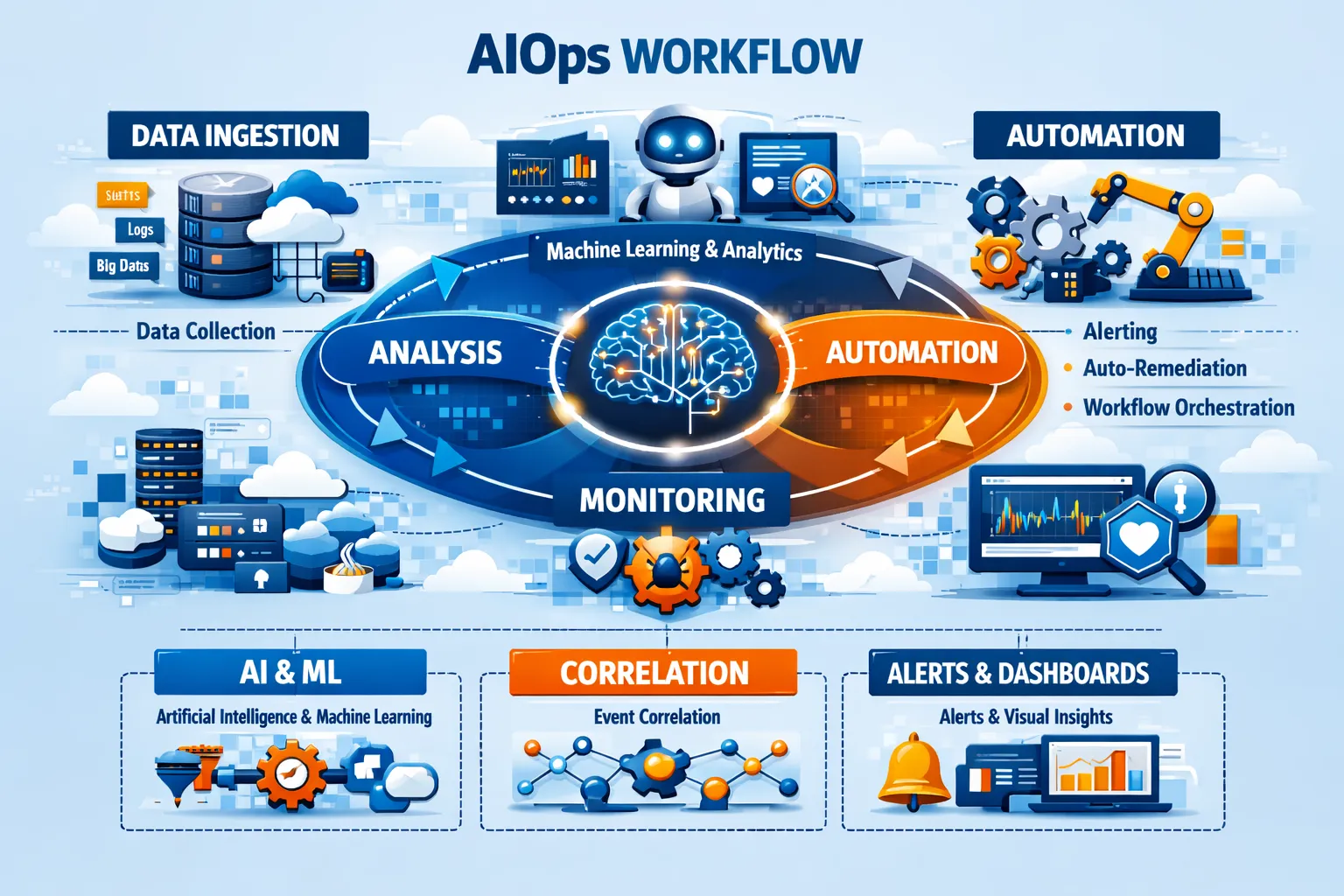
MLOps Taking Machine Learning from Notebook to Production
Building a machine learning model that performs well in a Jupyter notebook is one thing. Keeping that model running reliably in production — serving real predictions to real users, staying accurate as data changes, and being retrained and redeployed safely — is an entirely different challenge. Industry studies have repeatedly found that a large share of ML projects never make it to production, and many that do fail to deliver lasting value because nobody built the operational discipline to sustain them. MLOps exists to close that gap.
What Is MLOps?
MLOps (Machine Learning Operations) is a set of practices that combines machine learning, DevOps, and data engineering to deploy and maintain ML models reliably and efficiently in production. It extends the automation, collaboration, and continuous-improvement principles of DevOps to the unique challenges of the ML lifecycle: managing data, tracking experiments, versioning models, and monitoring for a particular kind of decay that software doesn’t normally experience — model performance degrading as the real world changes.
MLOps sits at the intersection of three disciplines. From DevOps, it borrows CI/CD, automation, and infrastructure as code. From data engineering, it borrows pipeline reliability and data quality practices. And it adds a layer specific to ML: experiment tracking, model versioning, and performance monitoring tied to statistical accuracy rather than just uptime.
Why MLOps Matters
Machine learning introduces operational challenges that traditional software doesn’t have:
- Models decay over time. Unlike a stable piece of business logic, a model’s accuracy can silently degrade as real-world data drifts away from what it was trained on — a phenomenon called model or data drift.
- Reproducibility is hard. A model’s behavior depends on code, data, hyperparameters, and the training environment all at once, and any of these can quietly change between training runs.
- Experimentation is central to the work. Data scientists routinely run dozens or hundreds of experiments before finding a good model, and tracking what was tried, with what data, and with what results becomes unmanageable without dedicated tooling.
- The gap between data science and engineering. Data scientists are often optimized for exploration and accuracy, while engineers are optimized for reliability and scale — and models frequently get “thrown over the wall” between them, echoing the original Dev/Ops divide.
- Regulatory and ethical scrutiny. In regulated industries, organizations increasingly need to explain why a model made a particular prediction and prove that it was trained and deployed responsibly.
The Machine Learning Lifecycle
MLOps practices span the full lifecycle of a model, not just the moment it’s deployed:
-
- Data collection and preparation
- — sourcing, cleaning, and labeling data that will train the model.
- Feature engineering — transforming raw data into the inputs a model actually learns from.
- Model training and experimentation — trying different algorithms, architectures, and hyperparameters, and tracking the results.
- Model validation — evaluating accuracy, fairness, and robustness before anything is deployed.
- Deployment — packaging and serving the model so it can generate predictions in production, whether via batch jobs, real-time APIs, or embedded on-device inference.
- Monitoring — tracking prediction accuracy, latency, and data drift once the model is live.
- Retraining and iteration — updating the model as new data arrives or performance degrades, and safely rolling out the new version.
MLOps treats this as a continuous loop rather than a one-way pipeline: production monitoring feeds directly back into retraining decisions.
Core Practices in MLOps
1. Version Control for Code, Data, and Models
Beyond versioning code, MLOps requires versioning datasets and trained model artifacts, since a model’s behavior can only be reproduced if you know exactly which data and code produced it.
2. Experiment Tracking
Tools that automatically log hyperparameters, metrics, and artifacts for every training run, so teams can compare experiments systematically instead of relying on scattered notebooks and spreadsheets.
3. Automated Testing for ML
Beyond standard unit and integration tests, ML systems need data validation tests, model performance tests against held-out benchmarks, and checks for fairness and bias before deployment.
4. CI/CD for Models
Extending continuous integration and delivery to include automated retraining, validation, and deployment pipelines — so a new model version can be tested and rolled out with the same rigor as an application code change.
5. Model Registries
A central, versioned catalog of trained models, tracking which version is in production, which are archived, and the full lineage of how each was produced.
6. Production Monitoring
Tracking not just system health (latency, uptime, error rates) but model-specific health: prediction distributions, accuracy against ground truth as it becomes available, and drift between training and live data.
7. Governance and Reproducibility
Maintaining audit trails of what data trained a model, who approved its deployment, and how it performs across different populations — increasingly a compliance requirement, not just good practice.
The MLOps Toolchain
A typical MLOps stack draws on tools across several categories:
- Experiment tracking and model registry: MLflow, Weights & Biases, Neptune.
- Pipeline orchestration: Kubeflow, Apache Airflow, Metaflow.
- Model serving: TensorFlow Serving, TorchServe, KServe, Seldon Core.
- Feature stores: Feast, Tecton — centralizing and reusing engineered features across training and serving.
- Monitoring: Evidently AI, WhyLabs, Arize — specifically built to detect data and model drift rather than just infrastructure metrics.
- Infrastructure and deployment: Docker and Kubernetes, alongside cloud-native ML platforms like SageMaker, Vertex AI, and Azure ML.
As with DevOps and DataOps, no single toolchain is universally correct — the right stack depends on team size, model complexity, and deployment environment (cloud, on-premises, or edge).
Benefits of Adopting MLOps
Organizations with mature MLOps practices typically see:
- Faster time from model development to production, since automated pipelines replace slow, manual handoffs between data science and engineering.
- More reliable models in production, as automated testing and monitoring catch data drift and performance regressions before they cause real business harm.
- Reproducibility, allowing teams to recreate and debug any past model version rather than losing track of what actually produced a given result.
- Faster iteration cycles, since experiment tracking and automated retraining pipelines make it far easier to improve models continuously rather than treating deployment as a final, one-off event.
- Better collaboration between data scientists, ML engineers, and operations teams, replacing ad hoc handoffs with shared tools and shared accountability.
- Stronger governance, with clear audit trails supporting compliance and responsible-AI requirements.
Common Challenges
MLOps adoption tends to hit a recognizable set of obstacles:
- Cultural and skills gaps. Data scientists are not always trained in software engineering practices, and engineers are not always familiar with the statistical nuances of ML, creating friction in shared ownership.
- Silent model decay. Unlike a crashed service, a model that has quietly degraded in accuracy often produces no obvious error — just slowly worsening predictions — making it easy to miss without dedicated monitoring.
- Data dependency risk. Because a model’s behavior is inseparable from its training data, changes to upstream data pipelines can silently break a model even when nothing about the model itself changed.
- Tooling immaturity and fragmentation. The MLOps tooling landscape is younger and more fragmented than the DevOps ecosystem, and stitching together experiment tracking, orchestration, serving, and monitoring often requires significant integration work.
- Governance overhead. Especially in regulated industries, the additional documentation, testing, and approval processes required for responsible deployment can slow down teams that aren’t prepared for it.
The Future of MLOps
Several trends are shaping where MLOps goes next:
- LLMOps. The rise of large language models has spawned a related discipline focused on prompt versioning, retrieval-augmented generation pipelines, evaluation of generative outputs, and cost/latency tradeoffs unique to foundation models.
- Automated drift detection and retraining. Increasingly, monitoring systems don’t just alert on drift — they trigger automated retraining and validation pipelines, closing the loop with minimal human intervention.
- Responsible AI tooling. Bias detection, explainability, and fairness testing are moving from optional add-ons to standard stages in the MLOps pipeline, driven by both regulation and reputational risk.
- Convergence with DataOps. As feature stores and shared data pipelines become central to ML workflows, the line between DataOps and MLOps continues to blur, with organizations increasingly treating them as a single, unified data-and-model lifecycle.
- Edge and on-device ML operations. As more inference moves to edge devices and mobile hardware, MLOps is extending to handle versioning, monitoring, and updates for models that aren’t running in a centralized cloud environment.
Conclusion
MLOps exists because a trained model is not a finished product — it’s the starting point of an ongoing operational responsibility. Reproducibility, monitoring, and automated retraining aren’t bureaucratic overhead; they’re what determines whether a promising model in a notebook becomes a reliable system that keeps delivering value as the real world it was trained on inevitably changes. Organizations that invest in MLOps discipline early tend to be the ones whose ML initiatives survive contact with production — and keep working long after the initial launch excitement fades.
Links: Google NotebookLM, IBM WatsonX, Oracle Machine Learning (OML)